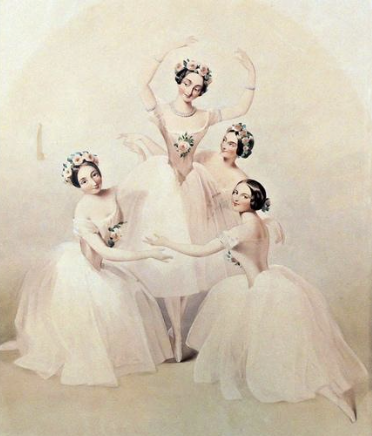
Around 1845, British artist Alfred Edward Chalon produced an iconic watercolor that has largely fixed the image of dance in the mid-nineteenth century. His Pas de quatre (fig. 1) depicts four of the outstanding ballerinas of the period –the Italian dancers Fanny Cerrito, Carlotta Grisi, and Marie Taglioni, alongside the Dutch dancer Lucile Grahn—performing together at Her Majesty’s Theater in London, in a piece choreographed for them by Jules Perrot which cemented the image of the Romantic ballerina, not least for their costuming: floating full skirts with a fitted bodice and stiffened pointe shoes which enhanced the dancer’s air of weightlessness. The overwhelming impression is one of homogeneity, femininity, and ethereality.
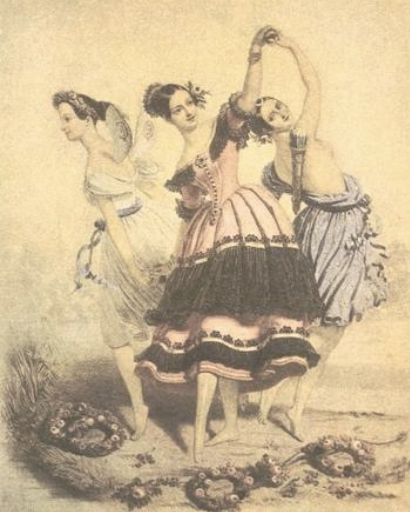
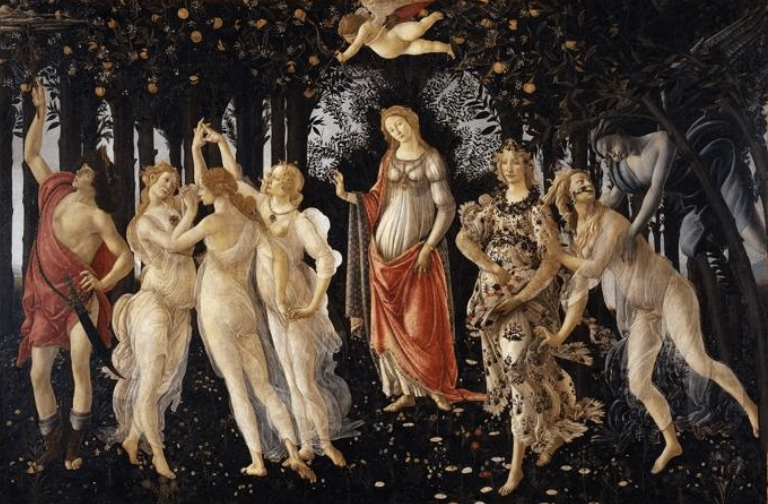
The actual horizon of dance in the mid-nineteenth century is more accurately represented, however, in a slightly earlier image by the same artist, a lithograph produced by Chalon around 1840 and also featuring some of the outstanding dancers of the day, including two of those featured in the pas de quatre: Taglioni and Grisi. Here they are accompanied by the Austrian Fanny Elssler,1 and the lithograph, titled The Three Graces (fig. 2), draws a line back to an iconic image of dance produced in the Italian Renaissance: Sandro Botticelli’s late fifteenth century panel painting Primavera (fig. 3), often referred to as “The Three Graces” in reference to the three allegorical dancing figures depicted on the left of the painting, who epitomized graceful movement in an era when dance was returning to the public sphere as church strictures loosened.2 An entire history of classical ballet is condensed in Chalon’s backward glance.
Renaissance Italy was the birthplace of modern classical dance, in the lavish court spectacles fostered especially by the Medici family. In the sixteenth century, dance was brought from Italy to France and Russia and handed on from aristocratic amateurs to skilled professional dancers, its movements formalized in the academies and companies that began to be founded in Paris, St Petersburg, London and elsewhere. Over the following three centuries it flourished as an artform into the codified techniques, plots, and costuming that we today associate with the heyday of classical ballet, the mid-nineteenth century.
However, classical ballet was far from the only dance form popular in Europe in the 1830s and 40s, and indeed ballet itself was far from homogeneous in the styles it incorporated. Chalon’s lithograph spells this out for us in the striking diversity of the figures it includes. On the left is Taglioni, Romantic ballerina par excellence, depicted in a costume similar to the one she wore for her most famous role as La Sylphide in 1832: a knee-length tulle skirt, with wings to increase the illusion of her weightlessness. In the center is Fanny Elssler, indelibly associated with the earthy cachucha, a Spanish dance (drawn from the escuela bolera, Spain’s version of classical ballet) that she performed at the Paris Opera in 1836, in the three-act ballet Le diable boiteux.3 The Romantic ballerina therefore appears here in Spanish dress: a bodice and full skirt of pink satin and black lace, similar in shape if not color and detail to Taglioni’s dress, and similarly –indeed somewhat surprisingly—comprising soft ballet shoes, neither stiffened (as we might associate with ballet) nor percussive (as we will come to expect from flamenco). The trio is rounded out by a figure turned largely away from us, perhaps out of decorum: representing Diana the huntress, the dancer Carlotta Grisi wears a tunic that exposes a breast, and she is barefoot, looking back to the mythological masquerades associated with Renaissance Italy, but also uncannily forward to the neoclassical naturalism of Isadora Duncan and her followers at the turn of the twentieth century. In place of the ballet blanc aesthetic of the 1845 watercolor, then, Chalon’s early 1840s lithograph foregrounds diversity, albeit a diversity filtered through classical ballet: the foreign dance styles (Spanish cachucha, Greek mythological/pastoral) are here incorporated into ballet’s modes, through the bodies of a set of lauded Romantic ballerinas.4
It is curious to note, moreover, that the lithograph is haunted by more foreign forms still. Taglioni’s iconic Sylphide is from 1832, but in 1830 she had performed a stylized Indian temple dance in the ballet Le dieu et la bayadère,5 based on a poem by JW von Goethe, and she went on to present a much-applauded stand-alone ballet, La Bayadère, a year later in 1831, meaning that she might just as well have been represented here in orientalist garb – or, indeed, in Spanish costume, by virtue of her 1838 performance in La gitana. Elssler may now be primarily associated with her spectacular Spanish dance, but she was equally appreciated as a Romantic ballerina in classics such as La Sylphide and the slightly later Giselle; her tutu virtually shimmers through her Spanish costume. Carlotta Grisi, appearing here as Diana the huntress, was in fact the ballerina who premiered Giselle, and who shone in the role; yet she was also praised for her performances in both the Orientalist La Péri in 1843 and the Spanish-inflected Paquita in 1844, meaning that she too might have appeared in any one of these guises.
All of these dancers, in other words, represented a variety of dance forms, and we might well have the sense, watching this circle as it turns, that the dancers might easily change places: that the costumes might stay the same but the bodies might cycle through them without any great difference in gestural repertoire. It is a striking image of the synchronicity of an array of dance styles, all of them alluding to different moments in history and sites on the globe, yet sharing the mid-nineteenth-century stage. Dance, here, is both timeless and time-stamped: a “dance to the music of time”, to quote the title of another Renaissance painting that is also encrypted in Chalon’s lithograph. That painting (fig. 4), from 1634-36, is by Italian-trained French painter Nicolas Poussin; in place of Botticelli’s three graces, it depicts four figures moving in a circle, with some suggestion that the figure on the left of Botticelli’s painting—the male god Mercury—has been swept up in the dance. The figures move in a circle, their hands joined but their bodies, faces, and legs pointing in different directions.
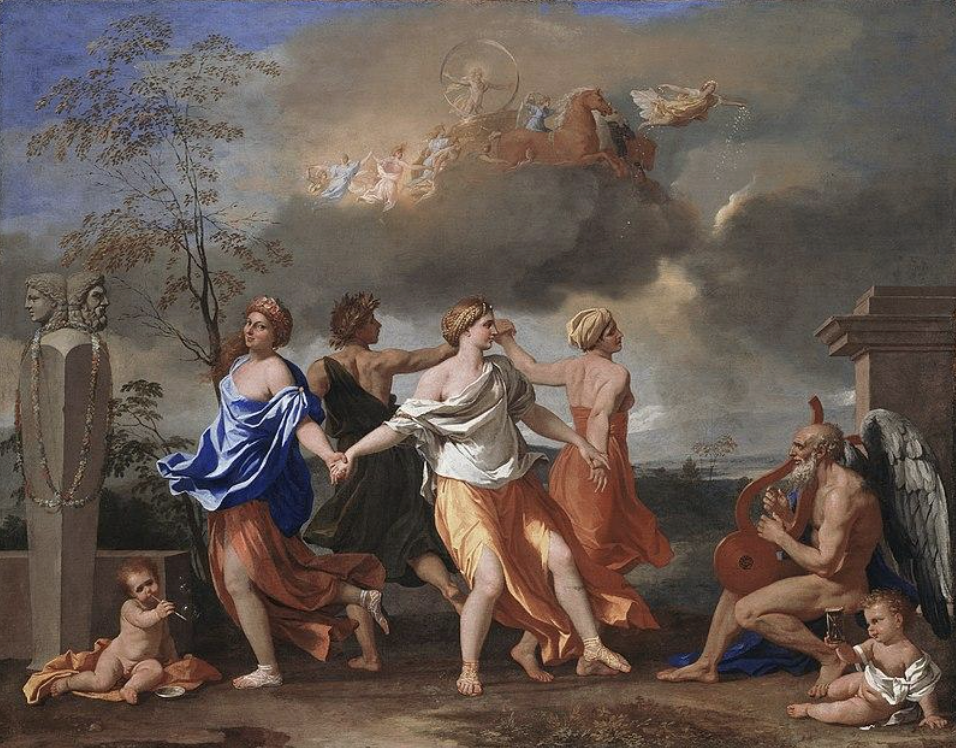
If we look closely, we can see that it is this same array of directions that Chalon is channeling in his lithograph. The dancers are not turned inward toward one another in the solemnity of ritual, as they are in Botticelli, but rather outward and away: moving in a joyous circle as in Poussin, each one’s weight is distributed differently, and each one turns their head toward a different object, as though they are all looking toward different publics. Instead of being directed toward a shared purpose –cementing the place of dance in a specific cultural milieu—they face toward an array of publics which each one will meet and connect and dance with in turn.
The three modes shown in Chalon’s lithograph –Spanish/folk, mythological, Romantic—were three key spokes in the wheel of dance in the mid-nineteenth century. A fourth, left unpresented, is quite a surprising absence. Oriental dance –a diffuse form encompassing South and Southeast Asian, Middle Eastern, and North African modes—was a critical presence both in fantasized and real form from the mid-nineteenth century through the early twentieth. I have already mentioned the bayadères who appeared in classical ballet through the performances of Taglioni and others in the early 1830s, spilling from page onto stage out of the Orientalist narratives that proliferated in the late eighteenth and early nineteenth centuries;6 and in 1838, an encounter with real Indian temple dancers in Europe would prove catalytic for conceptions of dance –classical, modern, and exotic—over the decades to come. As Avanthi Meduri puts it of what she calls a “nodal moment in global dance history” (301), this “first widely publicized point of contact between East/West dancers […] enabled the articulation of transnational dance modernism(s)” (299-300), and it will therefore be a starting-point for this study.7 It also, significantly, raised crucial questions about how dance was to be understood: as art, or as ethnography?8 And how did it relate to the shifting forms, styles, and spaces of popular entertainment, themselves in the process of shuffling their publics and their expectations?