The 1906 Pathé release Le tour du monde d’un policier [A Policeman’s Tour of the World], directed by Charles Lucien Lépine, turns Jules Verne’s 1873 novel Around the World in Eighty Days into a fifteen-minute film in which the driving motor is not science but capital. Clutching a briefcase of stolen loot, an embezzler on the run takes off from Paris with a detective in hot pursuit; their brief encounters take place in a French train station, a loading dock for the Suez canal, a Calcutta street, a Bombay temple, an opium den in China, the port of Yokohama, the city of San Francisco and a North American forest, where the detective is threatened by Native Americans, and his life, in a surprising twist, is saved by the embezzler, his erstwhile prey. United by a common foreign threat, they travel on together through New York back to Paris, where the embezzler learns that while he was traveling, his money was hard at work at home for him: making him enough money on the stock market to buy his innocence, found a new bank, and employ his former pursuer.
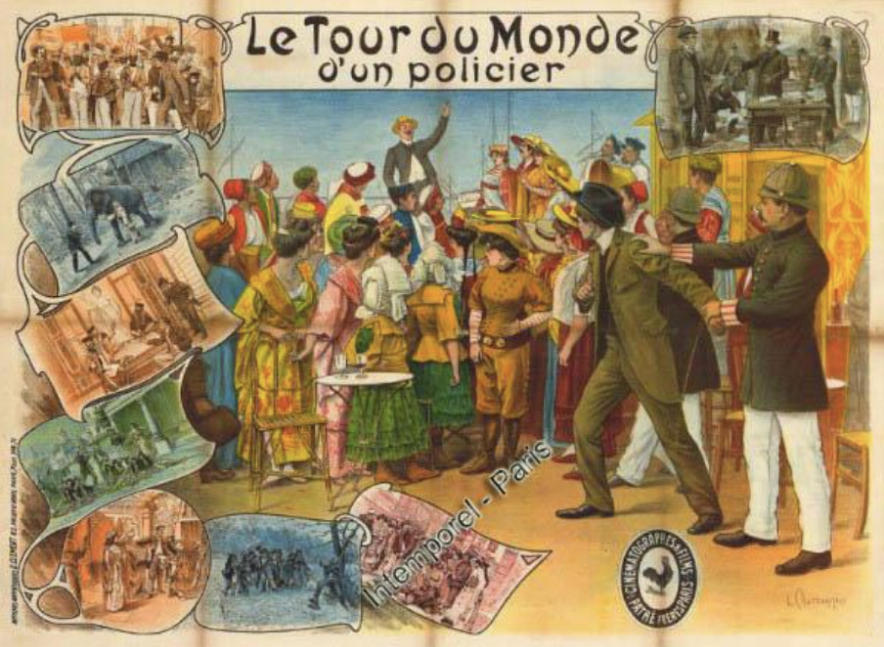
The film shares the novel’s urgency with getting its protagonist –and his case of cash—around the world as expediently as possible, offering a satirical image of the increasingly unrestricted flow of capital around the globe at the turn of the century. But it comes to a halt in a series of settings in order to allow its antagonists to cross paths with one another, and when it does so, it deploys a backdrop of other moving bodies: humans and animals in a street procession in Calcutta, a crowd of locals milling in the port of Yokohama. These moving bodies often have the effect of slowing down the film’s protagonist and/or his antagonist: they get in the way with their own need to be somewhere or get somewhere, suggesting that there are different urgencies at work in different spaces around the globe, and that the fast-moving foreigner –in flight across spaces he has no desire or plan to get attached to—occasionally bumps up against and even gets mired in a local panorama. In this panorama, local bodies who are usually in the background come to the fore, becoming the center of attention. And strikingly, they often do so dancing. At the Suez Canal, for instance, a dancer performs a sailor’s hornpipe; local women dance outside and inside a temple in Bombay; three more dancing figures appear as part of an opium dream in China; a larger group dances outdoors in the port of Yokohama.1 All of these figures capture the attention of the pursued and/or his pursuer, stopping their forward motion while granting them and the viewer moments of rest, taking over movement for themselves in momentary spectacles that bring each setting to life.
Creating the effect of authenticity was a key concern in the film. As Philip Rosen has detailed, Le tour du monde was cutting-edge in its weaving together of studio shots and location footage, alternating deftly between the two to bring together fiction and non-fiction, the ersatz and the real, and it is not coincidental that it should have drawn upon moving bodies in order to bring its diverse spaces –studio shots and location footage—to seemingly equal life.2 As Isabelle Flour notes, in the world’s fairs of the half-century leading up to Lépine’s film, indigenous bodies were frequently deployed as supplements to architectural simulacra, “authenticat[ing] the fictional settings in which they performed” (63).3 To set bodies moving within a material setting was to bring that setting to life, animating the streets and buildings in which they carried out their activities. These activities were often everyday –accounts of the world’s fairs are rife with instances of bodies carrying out quotidian tasks, a notorious example being the donkey-drivers of the rue de Caïre at Paris’ 1889 Exposition Universelle, analyzed by Timothy Mitchell 4 – but it was particularly dance that seemed to offer the stamp of authenticity, at once natural and cultural, atavistic and choreographed, ritual and artistic.5 Flour discusses in particular the Cambodian dancers brought to enliven the plaster-cast reproductions of Angkorean temples at the colonial expositions in Marseille in 1906 and 1922, then in Paris in 1931; those specific bodies had indeed been brought from Cambodia, if not quite from the king’s court retinue as publicity materials claimed.6 But in the case of many of the dancers we will encounter over the course of this chapter –and indeed of many of the bodies set in motion to animate world’s fairs—the question of authenticity was precisely questionable, often understood to be a fiction. While in the case of the Cambodian dancers –whose first visit to France took place in the same year that A Policeman’s Tour of the World was released—real foreigners were imported to enhance the reality effect of a plaster-cast setting, more often than not, foreignness was faked. As we will see, a majority of those performing exotic dances in the late nineteenth and early twentieth century had an altogether more tenuous relation to the cultures whose dances they performed. Sometimes their connection was grounded in biography or heritage, but far more often it was the result of study and/or travel abroad – or more often still, the claim to have studied and/or traveled abroad. Moreover, dancers in the period learned from one another on a shared performance circuit, borrowing and sharing styles and choreographies, creating a chain of performances, some of whose links were the result of origin, training, or study, but the majority of which were not: a fact known to audiences, but conveniently disavowed, disbelief suspended, in the place of performance itself. What we are dealing with here, then, are fictions of authenticity: an oxymoronic label that captures the pressures placed on bodies to represent an elsewhere for European audiences, even when most of those involved –dancers, critics, entrepreneurs, and publics—were aware that this representation was grounded in fiction.
Donec nulla felis, efficitur consequat ornare sed, maximus et nisl. Suspendisse consequat ultrices nisi nec interdum. Aliquam in nibh venenatis, facilisis felis non, rutrum orci.
Blockquote Attribution
This logic is emblematized in the closing tableau of Lepine’s Tour du monde, in which all of the dancers who had appeared in its daisy-chained spaces are brought together around an actual globe, underlining to the spectator that they have just been taken on a tour of the world, whose stops have in each case been “authenticated” by each place’s particular moving bodies. These bodies, despite being ostensibly tied to their locations, are here improbably brought together in the non-space of the film’s allegorical apotheosis, in which the dances of the world are gathered together to create a moving emblem of the cultures of the world, as well as to offer themselves up for comparison. This is a fitting image for this chapter, in which we will explore how dance becomes bound up with global imaginaries in what Heidegger famously called “the age of the world picture”. We will see dancers putting together eclectic repertoires comprising various forms of exotic, classical, and modern dance, turning themselves effectively into portable world’s fairs; we will encounter critics responding to those spectacles, writing comparative histories of world dance, drawing genealogies and connections across the intensely variegated panorama of modern dance in the early decades of the twentieth century; and we will start to trace the responses of a wide variety of publics to this work across a broad geographical horizon, responses inflected by questions of region, language, mobility, and class. Against this moving backdrop, we will explore the changing place of dance, its development from a “divertissement” to a serious art form and indeed vehicle of exploration in the passage between two centuries, fluctuating in the process between two poles: the ethnographic and the artistic, present in differing and oscillating degrees in the cases we will encounter.7
In chronological terms, this chapter traces the emergence of forms of early modern dance in the world’s fairs, music halls, and museums of the nineteenth century through the early twentieth century, in an arc that runs from the devadasi dancers of Pondicherry (India) brought to Bordeaux in 1838, through the dancers performing eclectic exoticizing repertoires in music-halls, variety shows, and the world’s fairs of Paris, Chicago, and St. Louis, to the massive cosmopolitan spectacles but also solo showcases that exploded across the theatrical panorama of Europe in the first decade of the twentieth century. All of these used dance to offer fictions of travel: travel represented by the dancers, for a public that wanted to feel itself transported. Meanwhile, those who were learning to write about and frame these dances, often with an eye to guiding the public in the proper reception of these new forms, participated in the construction of a global vision of dance, comparing dancers across a present-tense horizon, while composing at the same time a history of dance.
With the outbreak of the first world war, and the effective shuttering of European theaters, dancers themselves began to embark on actual travels: first to the neutral spaces of Switzerland and Spain, then onto broader cultural circuits, particularly a Latin American cultural circuit that was in large measure assembled and activated by the travels of those dancers, and in which dancers became involved in intricate local conversations about national cultures and their international projections.8 If dancers, as we will explore in what follows, were treated—and presented themselves—as practitioners of the world, offering portable images of eclectic repertoires for consumption and circulation by a broad variety of publics, they also engaged in surprisingly nuanced ways with the publics they encountered en route, leading to some unexpected cultural ventures I explore in this chapter and the next, involving not only dancers but musicians, artists, writers, and anthropologists. These ventures did not always get off the ground, but exploring them in their planning stages gives us a glimpse of the cross-cultural, cross-disciplinary collaborations being newly-imagined through and around the travels of dance.
This chapter thus begins with dance as a stand-in for travel, proceeds through an exploration of dance on its travels, and considers the ways in which traveling dance came to be conceived as a vehicle for both national excavations and international conversations.