Flitch disarmingly notes that one would have to be ubiquitous to give a proper account of the contemporary dance scene in the early 1900s, and this is an inordinately prescient point, given that his book coincides with the very early days of the practice of touring. Loïe Fuller, Isadora Duncan, Maud Allan, and others had recently begun to map out expansive circuits across the music-halls and concert halls of Western Europe as a way of earning a living by performing, keeping themselves constantly on the move, appealing to a variety of publics with the promise of novelty, whether in first appearances or return visits. In 1909, this practice took on quite a different dimension with Serge Diaghilev’s founding of the Ballets Russes: a large-scale enterprise featuring dancers on loan from the Russian Imperial Theater during its off-season, the practice of touring was inscribed in its very raison d’etre. In the inaugural “Saison Russe” at the Théâtre du Chatelet in Paris, enraptured audiences were introduced to the extraordinary dancers Vaslav Nijinsky, his sister Bronislava Nijinska, Anna Pavlova, Tamara Karsavina, Ida Rubinstein, as they performed a heady mix of dance styles, in tune with the eclecticism that governed the music-halls of the moment: Russian (the Polovstian Dances from Prince Igor), diffusely Oriental (the Pavillon d’Armide), Romantic (Les Sylphides), and fictionally Egyptian (Cleopatra). The next couple of years would see the company’s repertoire expand still further along these same eclectic lines, appealing in canny ways to audiences that had come to expect diversity in their dance programs: the Orientalist Sheherazade, reboots of the Romantic Giselle and Swan Lake, the fairy-tale Firebird and Spectre de la Rose, the carnivalesque Petrouchka. All were characterized by dazzling technical feats for soloists and eye-catching configurations for the corps, devised by the prodigious choreographer Michel Fokine, and amplified in their effects by the unusually sumptuous décor. 1

The dancer Nijinsky soon developed a second role as choreographer, delighting and scandalizing Paris audiences with his Apres-midi d’un faune in 1912 and, to an even greater degree, his Sacre du printemps in 1913. If the former shocked with its overt sexuality, the unfamiliar styles and steps of the latter were augmented by Igor Stravinsky’s discordant score, producing among the public what has been called a “riot at the Rite”. Even if recent accounts have questioned the accuracy of this description, it has gone down in history as one of the most important live events to have been present at in the twentieth century.2 As Richard Taruskin emphasizes, for all the provocations of its choreography, its score, and its mise-en-scène, the protagonist of this event was not Nijinsky, not Diaghilev, not Stravinsky, not impresario Gabriel Astruc, but the audience.3 Numerous artists claimed to have been in attendance that first night, such as American poet Gertrude Stein, who actually saw the second performance, four nights later. However, the audience was filled with figures from the French artistic scene and beyond: French poet and artist Jean Cocteau, Italian film-critic Ricciotto Canudo, Marxist revolutionary (and future Soviet Minister of Education) Anatoly Lunacharsky, and Stein’s close friend American dance and music critic Carl Van Vechten, who likely filled her in on the details. Argentinean intellectual Victoria Ocampo, on an extended honeymoon in Europe from 1912 to 1914, was there too for that night in 1913.4 Ironically, this means that she missed the company’s season in Buenos Aires just a few months later, to which we will return in a moment.
The Ballets Russes’ commitment to touring makes them a key referent for considering the reception of works in different regions, and as they traveled across different areas, as we will see in a moment, they encountered an array of publics involved in local modernizing projects, keen to make their responses to touring artists such as the Ballets Russes an active part of their process.5 The company’s movements also reveal a great deal about the performance circuits in existence in the period, which they themselves helped to forge and extend. If in 1909 they appeared only in Paris, their 1910 season looped in Berlin and Brussels; in 1911, after declaring themselves an independent company, they stretched the radius of their movement to include Rome and London. 1912 took them to various cities in Austria, Hungary, and Germany as well as Monaco, London, and Paris; and in 1913, after repeating this European circuit, they set off on a first tour of South America. Back in Europe in 1914, they spent the first eight months traveling in England, France, Germany, and Switzerland, before their performances were brought abruptly to a halt in late July. With the outbreak of war in Europe, and the shuttering of theaters, there was no longer a circuit to turn to. Therefore, in 1916, they embarked on the first of two successive tours of North America, interrupted by a short stint in neutral Spain during the summer. They returned to Europe in the spring of 1917, when they appeared in various Italian cities, followed by another short spell in Spain (and an unusual wartime appearance in Paris), after which they set off on a second and final tour to Latin America from August through October. Late 1917 through mid-1918 found them once again in Spain (and briefly Portugal), after which they gradually made their way back to the stages of London and Paris. As we can see, the tours of the Ballets Russes in the period give a clear indication of the closing of the European theatrical circuit during the war years, and the need to map out other possibilities for performance.
Other places, as it happened, were primed to receive them. US newspapers had been carrying reviews of Ballets Russes performances in Europe for some time, penned by reviewers making trips to or based in Paris;6 the same is true, as Claire de Robilant noted, of Latin America, to which we now turn our attention, which had received plentiful and mouth-watering accounts of Paris performances from writers and artists in France during the pre-war years.7 Several cities already had the infrastructure to receive them. Latin America had seen the sporadic visits of touring opera companies from the mid-nineteenth century onwards, and in some instances –Buenos Aires, Rio de Janeiro—had built lavish opera houses, but the Ballets Russes was the first major company of international renown to visit in the twentieth century, and by making the trip, they sent the message to performers elsewhere that the Latin American circuit was a viable and desirable alternative to the European one. It was also critical on the reception side. The company’s visit gave Latin American audiences and intellectuals a sudden sense of contemporaneity with the West, kindling the hope that other European icons would soon start to appear on the local front. In so doing, it gradually reorganized the continent’s spatial sense: prompting it to reconsider not only its connections to Europe, but also to think about the circuits that existed within the continent itself, and how touring performers might be passed along them. It also, just as crucially, had an effect on temporality: as Latin America began to envision itself as part of a much more expansive cultural circuit, audiences and intellectuals throughout the continent began to look forward to the arrival of artists, projecting a hope that they might arrive, and in the case of those who did, registering their lingering aftershocks.8
The Ballets Russes embarked on two tours of Argentina, Uruguay, and Brazil: the first in 1913, the second in 1917. To have seen the Ballets Russes in Europe was a badge of modernity, but this was nothing to match the frisson of their actual appearance in Latin America. The press was careful to prepare the public for their arrival, launching a campaign months in advance to remind local audiences of the praise earned by the company in Europe: for their choreography, the creative and technical skill of their dancers, their innovations in scenic design, and their musicality. On their first visit, traveling between Buenos Aires, Montevideo, and Rio de Janeiro, the Ballets Russes performed a reliably crowd-pleasing mix of some dozen of their Orientalist, Romantic, and Russian pieces, from Scheherazade through Swan Lake and the Spectre de la Rose to Prince Igor. In Argentina, audiences poured into theaters; newspaper notices (in both the Spanish and English press) blossomed around their performances; their dancers became a cultural draw as much offstage as on (particularly in the notorious case of Nijinsky, who shortly after setting foot in Buenos Aires, married a Hungarian dancer he had met on-board ship.)9 Reviews were particularly appreciative of the athleticism of their dancers, the lavishness of their sets and costumes, and the cutting-edge nature of their musical accompaniment – a triple focus explained by the fact that those reviewing their performances were often cross-assigned from the sports section, the arts section, and music criticism: three cognate areas for dance that together cobbled together a practical version of Wagner’s Gesamtkunstwerk.10 Montevideo, however, saw only two performances by the Ballets Russes, and as local papers noted, this was insufficient to give the audience a chance to adjust to their new art. Reviews in Brazil were more positive, singling out costumes and sets for particular appreciation, although the critics in Rio de Janeiro expressed some discomfort with the use made of musical scores, in a hierarchy which, they claimed, placed music at the very bottom of the company’s concerns.

To everyone’s surprise, the Ballets Russes returned to the Southern Cone in 1917, on the heels of their two-leg tour of North America, once again driven by the lack of opportunities for performance in war-torn Europe. Press notices for the dancing were increasingly assured, and full of praise for Nijinsky in particular; music critics were especially excited about the opportunity to hear Stravinsky’s Petrouchka. (There was still not a whisper of the Rite of Spring). However, a despair at the inability of local musicians to rise to the task rings out across the reviews, and undoubtedly put a damper on some of the season. Compounded by concerns over Nijinsky’s unreliability –he missed several performances, claiming irregularities in his contract—the reception for the company became somewhat frosty, and once Nijinsky effectively retired from the stage after a single performance in Montevideo, the company was beset by a number of practical problems, such as a fire on the train carrying sets for Scheherazade and Cleopatra.
Notwithstanding these setbacks, the legacy of the Ballets Russes in Latin America lingered on in unexpected ways. One of the remarkable things, indeed, about the Ballets Russes in the period was their tendency to seed new projects, whether on tour or via hearsay. One of the most striking examples is found in Argentina, where Nijinsky, avoiding the company he had come to mistrust, in 1917 made friends with two locals harboring extravagant plans for new national productions: the writer Ricardo Güiraldes, and the painter Alfredo González Garaño. Both men had spent time in Europe, where they had seen the Ballets Russes in Paris before their arrival in Buenos Aires; inspired by the company’s experiments in mining local motifs for avowedly modern productions, the two Argentineans began to toy with the idea of producing a ballet at home based on Indigenous themes.11 Their ideas drew upon conversations with Juan B Ambrosetti, director of the relatively new Ethnographic Museum of Buenos Aires, who was himself intensely engaged in gathering folktales from different parts of the country in the project of producing a fully-fleshed-out national imaginary. Güiraldes’ and González Garaño selected the legendary figures of Caaporá (an Indigenous demon) and Urutaú (a grieving young female lover), wrote the libretto, and drew up vibrant costume and set designs that owe equal debts to Andean ceramics, Ballets Russes modernism, and German expressionism.12

On learning that Nijinsky would once again be visiting Argentina in 1917, they decided to issue an invitation to him to choreograph and star in the ballet. The moment, in many respects, could not have been more auspicious. Sunk in paranoia, Nijinsky was toying with the idea of decamping to establish his own touring ballet company, and his reported enthusiasm for the project likely involved perceiving in it a new reservoir of motifs, neither Slavic (as in Sacre) nor ancient Greek (as in Faune) but an entirely foreign and unmined mythic repertoire. When he left the region later that month, Nijinsky suggested a meeting for all concerned with Stravinsky in Switzerland the following year – a meeting which never took place, as Nijinsky fell into psychiatric turmoil, and Stravinsky, apparently, never got wind of the project. The projected ballet literally fell to pieces, living on for a brief period in solo exhibitions of set designs.13
Curiously, this is the case with a number of Ballets-Russes-inspired projects in the region from this period, projects which foundered due to financial or other practical reasons, but which nonetheless merit discussion for what they tell us about dance’s place in cultural history. These projects were dreamed up by artists, writers, and musicians who saw in the Ballets Russes not only the latest modernity – emblematized in the company’s explosive effect on fashion and décor – but one that drew upon and incorporated national pasts: translating the Slavic past into the up-to-date, and offering a model for others to do the same. The Mexican painter Roberto Montenegro, for instance, passing through Madrid on his way home from a stint in Paris and a period of refuge in Mallorca, drew up plans for a ballet to be performed by Ricardo Baeza’s Compañía Dramática Atenea – with costumes and scenery by Montenegro himself, and to be titled, somewhat incongruously, Inca.14
Had Montenegro just seen González Garaño’s Caaporá exhibition in Madrid? As it turns out, his inspiration by the Ballets Russes could have come from multiple quarters. In Mallorca, like Güiraldes and González Garaño in Paris before him, Montenegro had become close to Catalan painter Hermen Anglada Camarasa, a long-time acquaintance of Diaghilev’s who regularly shared his enthusiasm for the Ballets Russes with the artists gathered around him. The magnetic pull exerted by the company, as this one example suggests, came from many directions: Paris, Mallorca, Madrid, Buenos Aires… And artists and ideas, as we will keep discovering during this book’s tours, were frequently out of place.
Further buttressing the argument that the Ballets Russes’ influence traveled far beyond the places where they actually performed, the late 1920s saw two separate projects dreamed up in Cuba by writer Alejo Carpentier and composer Amadeo Roldán. La rebambaramba, which involved love-triangles, abuses of power, and acts of revenge, carried clear echoes of the Spanish-focused Ballets Russes work premiered in 1921, El sombrero de tres picos; El Milagro de Anaquillé, featuring an intersecting cast of traditional and modern, local and foreign figures, sounds like the 1917 ballet Parade run through an anti-colonial filter.15
(Carpentier, who had spent formative teenage years in Paris from 1912-21, and whose passion for music and dance was apparent from an early moment, presumably heard much discussion of the Ballets Russes, and may have seen performances in Paris from 1919-21.) Further north, Lynn Garafola has helped to reconstruct what she terms a “lost ballet of the Americas”, the 1932 work H.P., featuring music by Mexican Carlos Chávez, artwork by Mexican Diego Rivera, and choreography by the young American dancer Catherine Littlefield.16
As Garafola notes, H.P., which knits together hemispheric motifs and concerns, speaks eloquently of the way in which “Ballets Russes works offered a model for transforming popular traditions into the raw material of a high modernist art” (222), and as Leonor Saavedra unpacks in a reading of Chávez’s modernist cosmopolitanism, the company offered the composer inspiration for ways of drawing together national motifs and experimental form.17
In all of these instances, lavishly interdisciplinary spectacles involving artists, musicians, and writers coalesced around the magnetic form of the Ballets Russes and tried to pull it toward an under-studied heritage, building Argentinean, Cuban, Harlem Renaissance and other motifs onto a Russian base. However, the same period also saw much smaller-scale imaginings involving the solo dancers who began to arrive in Latin America in droves, and who themselves became involved in the plotting of dance-centered national reimaginings. This is a popular version of the high-art collaborations in which the Ballets Russes engaged, involving not well-known artists, musicians, and writers, but a second tier of often little-known, anonymous, or emergent creators and intellectuals; and yet it resulted in some remarkably memorable emplotments of national imaginaries routed through the bodies of dancers arriving from afar.
A stream of dancers began to make their way onto the stages of Latin America from 1915 onward: Antonia Mercé (Spain), Isadora Duncan (America), Felyne Verbist (Belgium), Norka Rouskaya (Swiss), Anna Pavlova (Russia), and Tórtola Valencia (Spain/Britain), to name just a few.
They performed a jumble of repertoires –from Duncan-inspired neo-Hellenic and barefoot dances, through Spanish, Indian, and other “ethnic” dances of often dubious authenticity, to Italianate and Russian forms of classical ballet—but they showed a surprising sensitivity and receptivity to the specificities of local scenes on circuits that they themselves were actively tracing. It bears underlining, before we look at these circuits, that these were far from easy travels. The transatlantic crossing during the war years was fraught with peril; train travel was slow and challenging, particularly crossing the Andes from Argentina to Chile; travel up the Pacific coast or across the Caribbean often meant sharing a ship with cattle or cargo; and dancers battled invisible airborne presences, such as unaccustomed temperatures, mosquitos, altitude sickness, and from 1918-20, waves of the Spanish flu. Dancers had to negotiate or renegotiate contracts with unreliable impresarios upon their arrival; theaters and their publics needed to be prepared to receive this traveling art form, unfamiliar even to the critics charged with reviewing it; local orchestras had to be scraped together and trained on the spot to play new melodies; and as the war ground on, questions of paperwork and border-crossings became ever trickier, with companies in some instances having to leave dancers behind as their nationalities or allegiances fell into question. When we add to this a grueling performance schedule –often five or six nights a week plus matinees—with little lag-time between cities, the complexities of transporting luggage including scenery and costumes (often mislaid, damaged, or destroyed en route), and the sheer exhaustion of travel itself, the span of these tours, their complexity and duration, becomes all the more remarkable.18
What becomes surprisingly clear, when we trace their movements through clippings, correspondence, programs, advertising and other ephemeral forms, is that dancers on tour were not simply performing fixed repertoires to passive publics, gliding from theater to theater with no appreciation for the differences between their audiences and the intricacies of local situations. It is much more strikingly the case that as they traveled, settling for days or weeks in specific locations, they frequently became enmeshed in successive generative encounters with audiences and intellectuals alike, and that these in turn led to the evolution of their dances, the elevation of dance as a form of both art and knowledge, and the projection of local imaginaries onto their circulating bodies. Arriving from afar and embarking on looping tours of the continent, they entered into enmeshed dialogue with their hosts, taking inspiration from what they encountered on their travels, and allowing themselves (consciously or otherwise), to be conscripted for both national projects and continental conversations.
One of the clearest examples of this is offered by the case of Russian dancer Anna Pavlova. Initially associated with the Ballets Russes, from 1910 onward Pavlova led her own company, and in early 1917 she took this company on an open-ended tour of Latin America, effectively waiting out the war. The tour ultimately lasted two-and-a-half years, and it took her company the length and breadth of the continent and back again: from the Caribbean across the recently-opened Panama Canal, down the Pacific coast, across the Andes, through the River Plate and Brazil all the way back up to the Caribbean, and then –when it seemed the war would be unending—starting the continental circuit in reverse. Rather than heading home after the declaration of the armistice in November 1918, Pavlova opted to spend a few months in Mexico, a country she had not yet visited. Somewhat surprisingly, her arrival did not produce the expected box office receipts; the public was initially unmoved by her performances of European classical ballet. But local intellectuals, sensing that a national failure to appreciate the renowned dancer would reverberate across an international horizon, devised the plan of conscripting her for a Mexican project: a Fantasía mexicana, staged by artist Adolfo Best Maugard, as part of which Pavlova danced the jarabe tapatío on pointe, leading to a rapturous reception.19
We might be tempted to assume, hearing of Pavlova’s Mexican fantasy, that this is a familiar case of a European figure appropriating local aesthetics. However, if we look at this example from the Mexican side, what becomes clear is that we are rather –or at the same time—watching a Mexican transculturation of a European icon, with what seems, moreover, to have had a twofold aim: on the one hand, proving to audiences elsewhere that Mexican publics were capable of appreciating this circulating icon, and on the other, launching a Mexican popular form into elite orbit, inscribed on a dancer’s moving body. This speaks volumes about the shift in the place and role of dance in the period, whether performed by a classical ballerina (Pavlova’s case), a Spanish dancer (the case of Antonia Mercé, considered in detail in the next chapter), or an eclectic ethnic dancer (as with Tórtola Valencia, also on the horizon). Each kind of dancer was understood as being inspired by Isadora Duncan’s mining of classical Greek and Roman forms in the early 1900s, of which notice had arrived throughout the continent.20
Once these dancers began to visit Latin America on looping continental tours in the 1910s and 1920s, local intellectuals in the cities they visited quickly realized and capitalized on their twofold appeal. On the one hand, in conceptual attunement with Duncan’s model, these traveling dancers were seen as holding the potential to reanimate a national heritage in the process of excavation; with a little nudging, they could be encouraged to incorporate gestures and motifs from pre-Hispanic ceramics and textiles into their dances and costumes, and thereby to bring those forms to contemporary life for local publics. On the other, as local intellectuals quickly perceived, the dancer was likely to carry those forms further onward, carrying out a kind of advertising for national forms and helping in the process to forge a continental circuit. In other words, if a dancer could be encouraged to choreograph an Incan dance on her passage through Lima, she would perform it not just in local theaters but at subsequent points on a tour, and in those subsequent spaces, local intellectuals might in turn respond by inviting her to design a dance based on their national heritage. Thus it is that from the late 1910s we already find an array of touring dancers performing not only “danzas incaicas” but “danzas aztecas” and “danzas mayas”: an appropriative or appreciative exercise on the side of the dancers, which at the same time, amounted to a sort of continental competition being staged upon the bodies of the dancers. (It bears emphasizing that the dancers were far from unwitting collaborators in this: not only did they derive new dances from their conversations, but some began to amass their own collections of both pre-Columbian and contemporary art on their travels, and they carried these with them around and ultimately out of the continent).
We will look at the intricacies of one of these cases in the next chapter; for now, I want to emphasize that this is a process in which all the significant dancers on tour through Latin America were asked to participate, hinting at a shift not only in the conception of dance –a faith in its ability to body forth and thus reanimate forgotten heritages for local and ultimately foreign publics—but in the understanding of its role as a cultural connector. Occasionally, too, local arbiters perceived a kind of danger in these traveling dancers. We might point to the famous case of Swiss Norka Rouskaya, who one night in November 1917 performed for an appreciative bourgeois audience in Lima’s Teatro Municipal, before giving a second performance for Lima’s bohemia in the Cementerio General. This latter, danced to Chopin’s Funeral March and featuring clothing deemed less suitable offstage than on, was charged with desecrating a sacred space, and both the dancer and her hosts were thrown in jail. Despite the persecution that ensued, the appreciation between Rouskaya and her Peruvian hosts remained undimmed; in subsequent years she was to be found performing Incan dances, as well as Aztec and Mayan dances, in a clear sign of the appeal of pre-Columbian motifs for dance at the time.
The Andean pole seems to have been particularly magnetic for the dancers, perhaps because their visits coincided with a period of rigorous excavation of local sites, and due to particular advocacy on the part of the cultural sector in attending to Indigenous forms. We will see further examples of this in the next chapter, but I want to close here with the case of a dancer who not only dipped a toe in Incan dance but actually ended up writing an epic poem on one of the last members of the Inca royal family. American-born “ethnologic” dancer Russell Merriweather Hughes, born in 1898, belonged to a second generation of touring dancers, and indeed was inspired to take up a dancing career after seeing some key performances in her hometown of San Antonio: Pavlova in 1914, Ruth St Denis and Ted Shawn in 1915, and in particular, Antonia Mercé “La Argentina” in 1917. Mercé’s performance abruptly redirected Hughes’ interest away from diffusely “Oriental” dance toward Spanish dance as a discipline.21
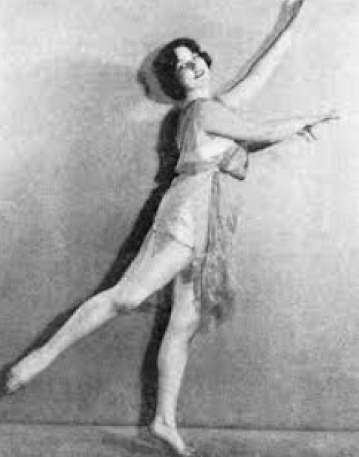
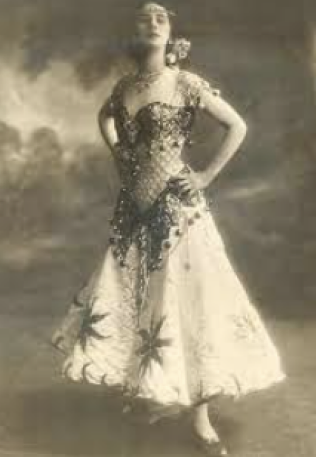
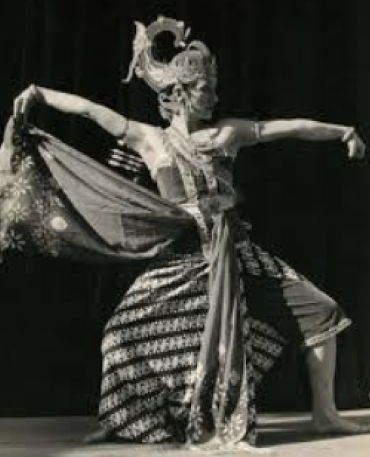
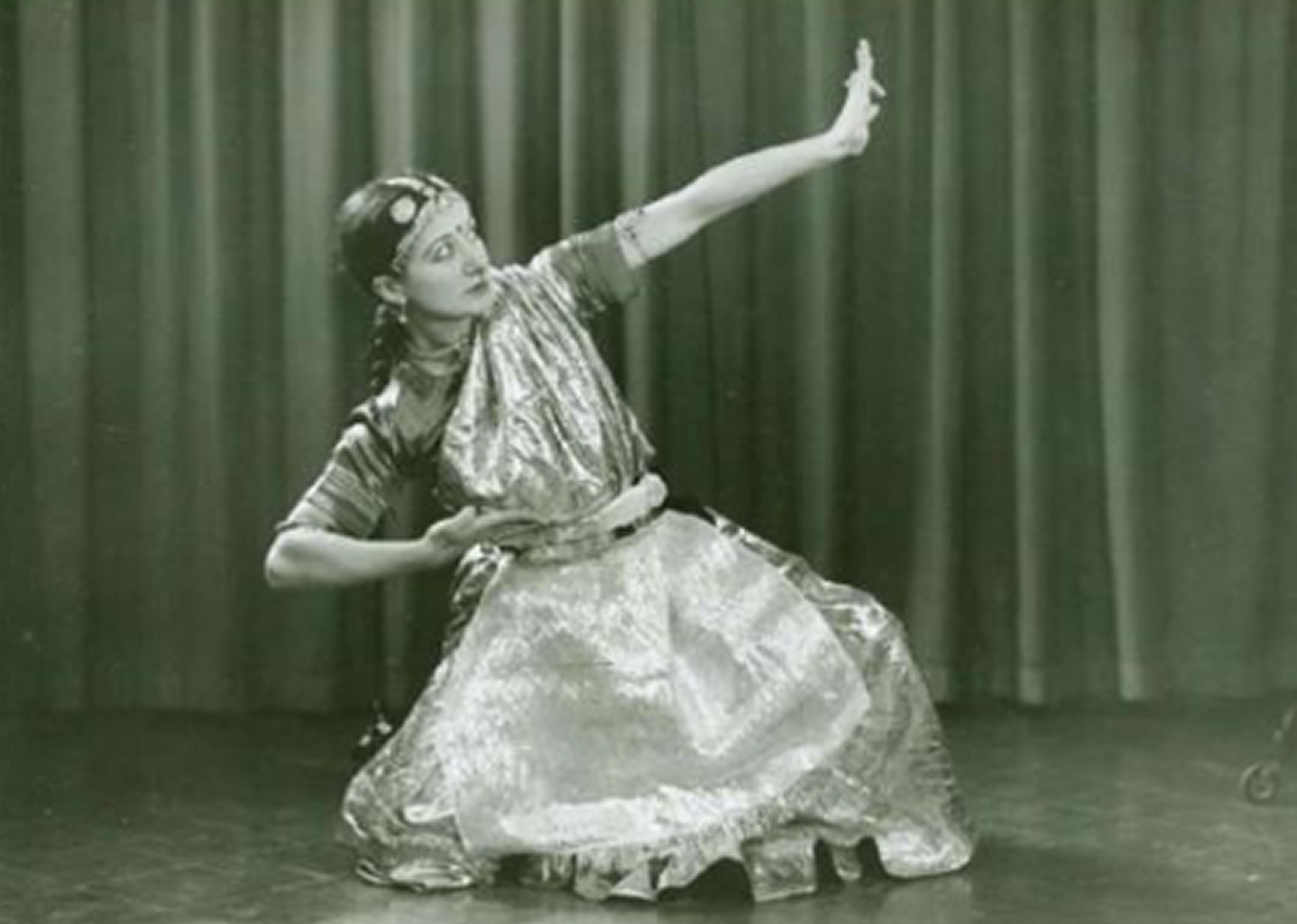
After some years studying and experimenting with dance styles in San Antonio and New York –years during which she also wrote a considerable amount of poetry—Hughes fell under the guidance of impresario Guido Carreras, who sent her on a short tour of Mexico. (It was on this early tour that she was given the Hispanicized stage name, La Meri, which she would retain throughout her career). On this somewhat anti-climactic tour (La Meri’s memoirs are wonderfully self-deprecating) she nonetheless developed a tremendous work ethic, which included a commitment to working with local experts. One of those was Pedro Valdez, who had taught Pavlova the jarabe tapatío, and who now successfully worked Spanish and Mexican dance forms into the body of this Texas dancer. After returning to New York for a longer stint, during which she appeared as a Spanish dancer in several large-scale productions, Hughes launched her career as a solo dancer in 1928, and embarked on a tour of Latin America.22
Hughes’ account of her travels is inordinately detailed, and some of its details are surprising. The first is that she worked with Japanese dancer Michio Ito to create her repertoire. Ito had moved to Paris from his native Japan to study music; through Dalcrozean eurhythmics, he found his way to dance, and as he moved in experimental circuits, he found himself in conversation with poets Ezra Pound and WB Yeats, and collaborating with two Indian dancers: Anglo-Indian Roshanara in the 1910s, and French-Indian Nyota Inyoka in the 1920s. He subsequently moved to New York, where he crossed paths with Hughes and assisted her in choreographing various Spanish dances, an eloquent case of artists working across ethnicities to hammer out stage versions of specific forms.
The second surprising detail, one that speaks volumes about the shifting place of dance as outlined above, entails the differing kinds of reception La Meri received during her 1928 tour. In Venezuela, she was received “like all visiting artists, with pomp”, including an invitation to the Presidential summer home. In the small towns and capital cities of Chile, Argentina, Uruguay, and Brazil, she performed for a wide variety of publics, while noting shifting degrees of comfort with appearing as a female dancer both on and offstage. In Lima, she received a special invitation to perform in an event titled “The Vision of Viracocha”: a yearly celebration of then-president Augusto Leguía, in which she performed two solos, taught to her by a “professor of Inca culture, himself an Inca, [who] helped me assemble examples of the ancient garments”. It is extremely unlikely that La Meri, grateful for the attention she was receiving, understood the nature of the regime she was being called upon to celebrate. (The dictatorial Leguía, who had draped himself in the symbolic mantle of the Inca Viracocha, would be deposed just a year later and thrown in jail for his repressive tactics). The conscription of a touring dancer into sometimes fraught local politics, begun a decade earlier, here reaches its zenith: the dancer is no longer being asked to bring static images of a repressed culture to life, but is rather deployed to legitimize a present-day ruler’s pretensions to himself reincarnate the past.
More intriguing is the direction in which she took the experience. Spending her days reading Peruvian history in preparation for her dances, La Meri found herself writing a “long narrative poem on the fall of the Incan empire”.23 A three-act epic poem in iambic pentameter, Huascar, Last King of the Incas runs to thirty-five typescript pages, and it shows a deep familiarity with Andean history, based on conversations with local intellectuals and study in Lima’s libraries and museums.24 Peppered with Quechua terms and place-names, referring with confidence to the history of the Inca empire, it tells the story of Huáscar, emperor from 1527-32, defeated in a civil war by his brother Atahualpa, in turn ousted by Pizarro. In La Meri’s poetic drama, Huáscar attempts to warn his father and others of an approaching cataclysm: the sensed arrival of emissaries of another empire, spelling doom for the Incas.
It shall come to stay, and staying, kill,
Killing not only our breathing bodies’ flesh,
But crushing our minds, our hearts, our very souls. (2)
Filled with Homeric resonances, Shakespearean power-struggles, self-examining soliloquies, and studies of omens, incorporating scenes of music and dance, dream and vision, it is a tale told largely through the filter of Huáscar, who listens to his own Cassandra-like prophesies “as though he were the mouthpiece of one dead” (3). “Nothing that’s true and good of us shall live”, he despairs. “No one shall sing our songs. No one shall read / the intricated patterns of our poets” (2). Those patterns may be oral, textual, even textile-based (there are numerous references to narrative-keeping quipus in the poem), but I would suggest that we also think of them as choreographic. In a narrative poem composed in tandem with her Inca-inspired dance solos, La Meri draws a continuum between dance movements and poetry, gesturing back to the choral origins of Greek dance, while modeling modes of recovery across cultures in the present.
La Meri’s movements between writing and dance, little explored by the few who have written about her, make her an unusual figure among her peers: a dancer-translator who moved with ease between the textual and the choreographic, between written and danced languages, and indeed between different dance styles: in subsequent years she would become a leading figure in the development of ethnic dance studies in theory and practice. Teaching students an array of gestural languages from across a global horizon –at the Ethnologic Dance Center in New York, Ethnic Dance Arts, Inc. on Cape Cod, and Jacobs Pillow in western Massachusetts—she choreographed both regionally-specific ethnic dances (primarily Spanish and Indian, the two forms under whose broad umbrellas she had studied most assiduously) and hybridized forms, such as her 1944 Hamsa-Rani, a Pavlova-inspired swan dance translated into Hindu gestural forms.25
But what is critical to underline about La Meri’s cross-cultural and hybridizing experiments is that they are utterly grounded in serious study: a slow-moving immersion in texts and in bodily practices that characterized her own touring practice, and that equally sets her apart from the first generation of touring dancers (not to mention many of her contemporaries). As La Meri notes in her disarming memoir, the times between performances, the travel-related pauses in touring (a very different version of the intervals in which Duncan and other dancers installed themselves) were critical for developing a relation to each place as she traveled, for building up relationships with local experts, and for drafting new dances: always in conversation with living bodies, while always, also, learning from readings.26
What is still more remarkable is that La Meri went on to translate this into writing, and to advocate in her writings for dance as a mode of global understanding. In her Total Education in Ethnic Dance, borrowing the terms of the translator, and answering Flitch’s call for an attention to the broadest dance horizon, she proposes:
In a world hourly growing smaller it behooves us as human beings to understand something of the peoples of this rapidly shrinking world. The student of ethnic dance has the shortest possible cut to the understanding of alien peoples, for he can learn to know them without climbing the barrier of language. He can know them through movement. For it must always be remembered that ethnic dance is the direct and honest expression of the people who gave it birth. Thus by trying to move as they move we understand them better.
With this statement, La Meri rewrites the film we encountered at the beginning of this chapter: a film which saw an agent of capital racing around the globe, trying to get from West back to West with the smallest number of interruptions, yet tripped up constantly by the moving bodies encountered on his route. La Meri, by contrast, like the touring dancers before her, enjoins us to linger with the bodies bumped into, to learn their languages, to enter into a moving conversation, before it is too late.