From the second half of the nineteenth century onward, publics across the West were most likely to encounter dance not in a dedicated space, but shuffled together with an array of other attractions in the enormously popular new entertainment venues that were music-halls and cabarets.1 Launched in England in 1850 and finding quick footing over subsequent decades throughout the western hemisphere, these spaces not only authorized performers to appear in costume, but allowed patrons to consume food and beverages alongside the show. This made for a more casual but also a rowdier set of entertainments, geared to appeal to the more distracted (and often more inebriated) viewer. In these new venues, variety was the name of the game; solo dancers found themselves alternating in quick-fire programs with acrobats, performing animals, singers, and illusionists, competing for audience attention alongside other modern forms of entertainment. They were also, of course, competing with one another, and to stand out in the crowded variety landscape, dancers frequently dedicated themselves to the cultivation of a particular style, which often meant aligning themselves with a particular ethnicity: presenting, for instance, Spanish, Indian, or Cambodian dances. Sometimes they coincided with the regional styles they claimed to represent; as Anne Décoret-Ahiha details in her indispensable book on exotic dance, many of the foreign dancers employed at the world’s fairs were also performing in the music-halls, and as Fauser notes, much of the dance and even some of the dancers seen at the world’s fairs would already have been known to publics from these other performance spaces.2 Traffic between the two, moreover, was not just material but conceptual. If world’s fairs tended toward the presentation of foreign dancers in simulated environments –placing emphasis on the real, or at least on reality effects—music-halls, variety shows and revues tended rather to foreground fiction and fantasy. The fantasy was often fanned by the dancers themselves, who began to produce false pedigrees justifying their relation to the dances they performed: invented biographies, imagined travels, and (more plausibly) incipient studies in the museums and libraries that offered –like the music-halls and world’s fairs where they were dancing—fragmented images of foreign cultures.3
As dancers and publics alike moved back and forth between these distinct spaces, dance itself slid to and fro along a spectrum between ethnography and entertainment, and dancers began to infiltrate the spaces of book-learning and high culture: researching and performing in libraries and museums, showcasing their findings in salons, presenting their art as an artistic response, a pedagogical embodiment, or an intellectual extrapolation of objects from the past or from other cultures. The impulse behind this is, of course, from our contemporary perspective, frequently questionable, but it is critical to bear in mind the circuits within which dancers were performing and developing repertoires in the late nineteenth and early twentieth centuries: circuits which were driven partly by novelty and partly by familiarity, in which dancers cut their teeth and made their mark by performing either something entirely new or something entirely familiar. In the competition to stand out, what was critical was the ability to produce an eye-catching original or an impressive imitation, and as dancers strove to distinguish themselves from other body-artists in the variety and circus scenes, self-presentation as an experimenter or an explorer became a striking feature of many repertoires. What is perhaps most surprising is that this took place less within the space of the museum or library than in the music-hall, an unexpectedly popular laboratory for experiment in the period.
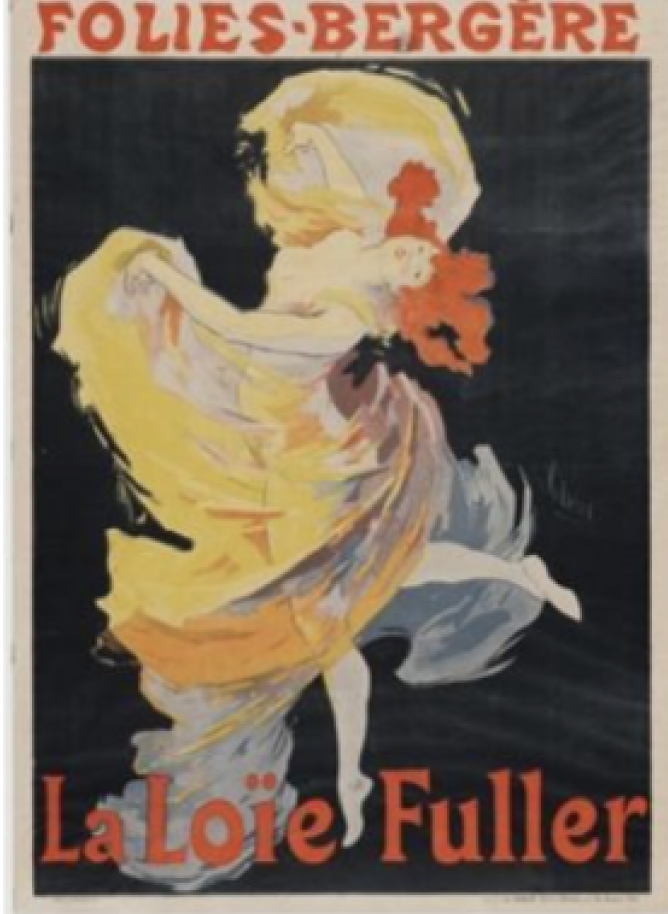
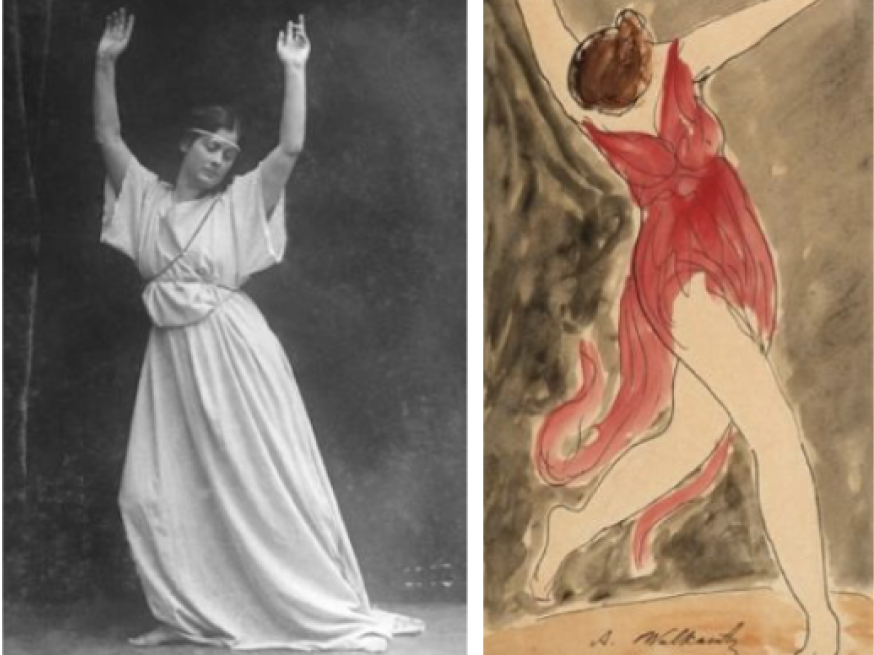
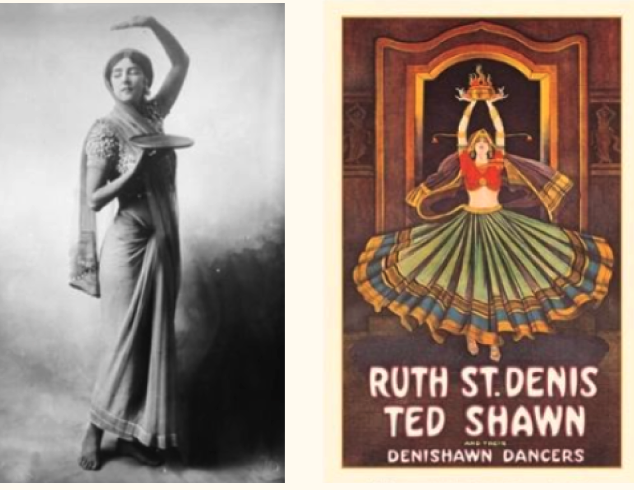
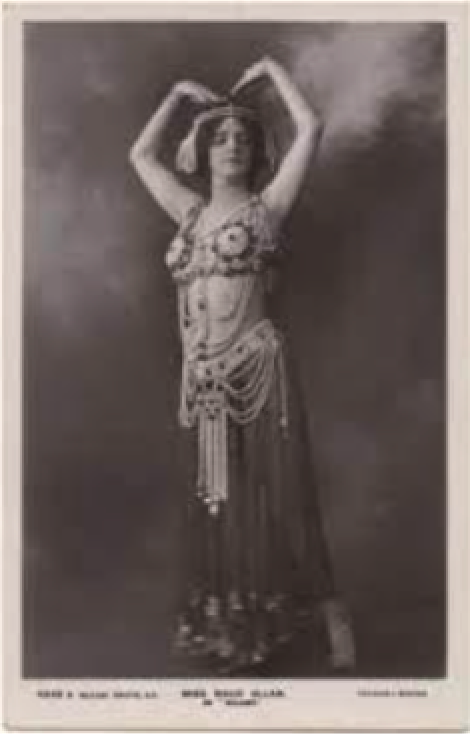
It is hard to overstate the importance of music halls in general –and their cognate spaces, circuses and cabarets—as a launching site for dancers in the late nineteenth and the early decades of the twentieth century. Pioneering dance artist Loïe Fuller (1862-1928), for instance, born in Chicago, began her career with Buffalo Bill’s touring shows in the 1880s, and first found success in Europe as a skirt dancer at London’s Gaiety Theater; she presented her most famous performances, manipulating bolts of cloth and lighting, at the Folies Bergère, more usually associated with comic operas, music-hall revues, and striptease. San Francisco-born Isadora Duncan (1877-1927) performed in a string of variety theaters across the United States and London before touring with Loie Fuller in Europe; she established herself as a serious dance artist via her unorthodox association with museums and libraries, making study central to her performance style, helping her to dance her way back into Greek and Roman codes of gesture, which she did not only in elite salons but in popular music-halls. Ruth St Denis (1879-1968), born Ruth Dennis in Newark, launched herself into stardom via vaudeville, first in New York, then on a touring basis; it was while performing in Buffalo that she claimed to have had the epiphany that led to her pivot toward dances of Egyptian, Indian, and Japanese inspiration, allegedly triggered by a cigarette-ad showing Egyptian deities.4 She carried these dances to England, France, and Germany, and indeed her memoir draws perceptive contrasts between audiences and expectations in the various countries where she performed. Canadian Maud Allan (1873-1956) began her career as a musician, moving to Berlin to study piano before shifting her focus to dance; she performed choreographies set to a range of classical composers (from Beethoven to Debussy) in variety shows across Europe before scandalizing audiences with her dance in the play Vision of Salomé, which premiered in Vienna in 1906, and had an enormously successful run in London in 1908.
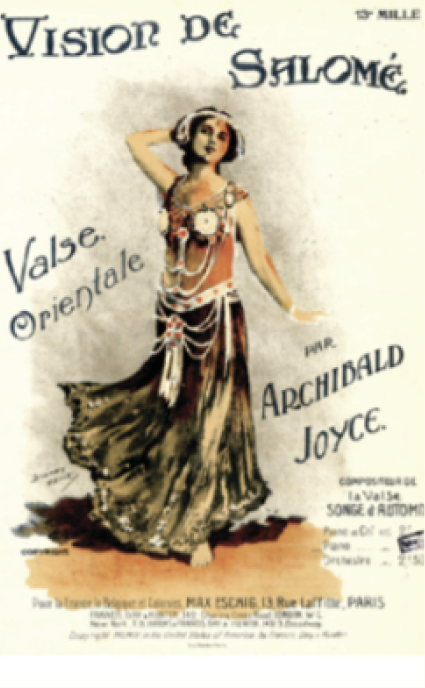
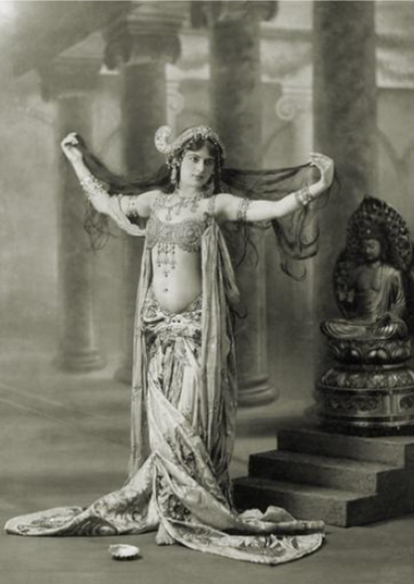
Shifting our focus to dancers from Europe, a notably exoticist strand of performance is exemplified by dancers such as Mata Hari (Margarite Zelle, 1876-1917), Sent M’Ahesa (Else von Carlberg, 1883-1970), or Roshanara (Olive Craddock, 1894-1926) – all dancers who styled themselves as Arabic, despite their diverse origins (Dutch, Latvian, and Anglo-Indian respectively), and who performed repertoires braiding together the erotic and the exotic.
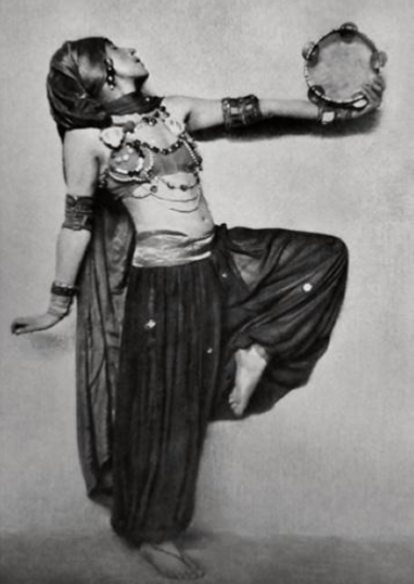
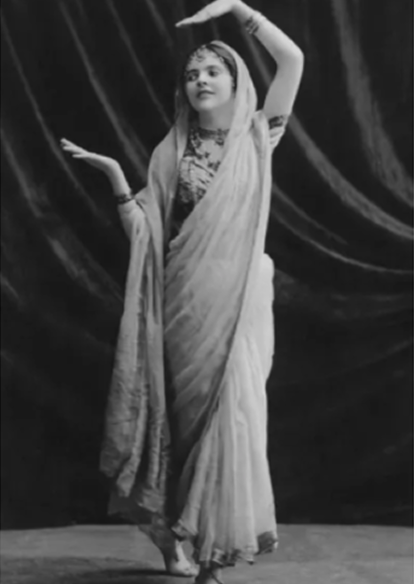
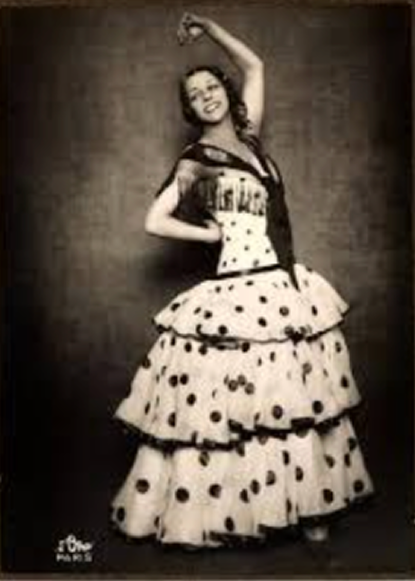
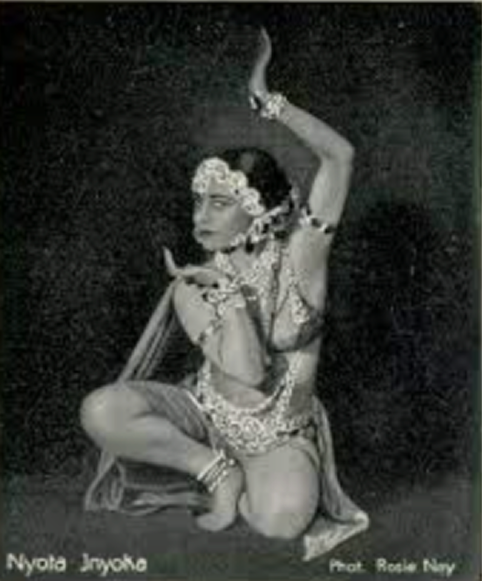
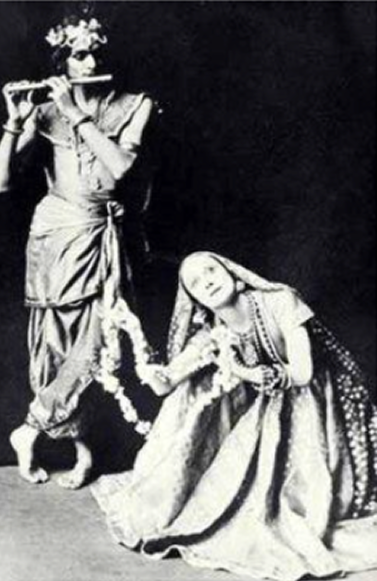
At the same time, and often in the same spaces, dancers arriving in Europe from farther-flung parts of the world (often from former colonies, but also including Spain, usually thought of as Europe’s exotic neighbor to the south) threaded a needle between using the music-hall as a space to explore their own cultural inheritance and shaping that heritage for local publics, creating hybrid styles and repertoires that blended what they encountered on their travels with the forms they had brought from home. Antonia Mercé (1890-1936), for example, dedicated herself to honing a repertoire of Spanish regional dances, progressively incorporating dances she encountered on her travels in Asia and Latin America; French-Indian Nyota Inyoka (1896-1971) developed a repertoire of Indian dances inspired primarily by her engagement with materials in French museums, most notably the Musée Guimet, which was also patronized by Mata Hari; the Indian dancer Uday Shankar (1900-1977), who began his career as a visual artist, in 1923 was invited by Russian ballerina Anna Pavlova to collaborate on an Indian-themed dance for the music-hall circuit, and he subsequently reoriented his activities toward the recovery and modernization of Indian classical dance, both in Europe and at home.5
With this array of styles on the horizon, it is not difficult to imagine how dance began to be conceived of as a mode of access to cultures distant in time or in space, whether performed by a dancer authentically representing those cultures, or offered as a fiction. This was not taken as an impediment. A dancer performing choreographies and gestures to which they were linked by heritage offered a window onto an unfamiliar world; a non-native dancer, by contrast, inhabiting a foreign code of gesture, at the same time modeled a way for audiences to imagine themselves elsewhere and otherwise. In this latter logic, what was uppermost was not authenticity, but the ability to turn dance into a mode of transport, located along a sliding scale between ethnography and entertainment. Indeed the very variety of dances on display around the turn of the century offered audiences fantasies of travel, plunging them into the heart of unknown movement scenes and introducing them to unfamiliar (if clichéd) gestures and practices, in a smooth continuation of the spectatorial habitus inculcated by the world’s fairs.
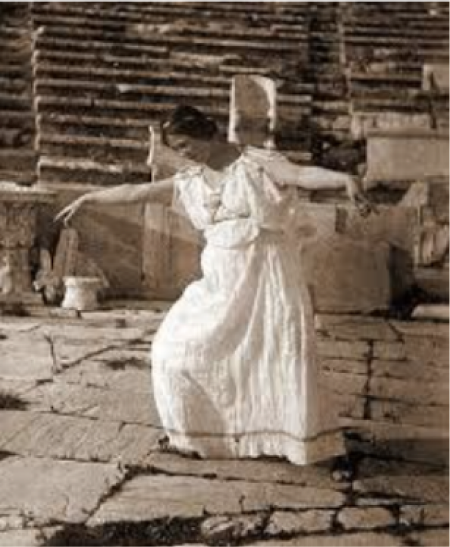
In a small leap of logic, what presented itself as an ersatz mode of travel also lent itself to travel in time. In other words, a dancer performing gestures from another culture might just as easily perform gestures from the past, carrying an audience with her into an exploration of other moments in history.6 This was the logic behind Isadora Duncan’s explorations of Greek and Roman style, derived from her reading of musicologist Maurice Emmanuel’s enormously influential 1896 study La danse grecque antique (d’après les monuments figurés), which aimed to derive movement sequences from the static images depicted in friezes, on ceramics and in statuary.7 The effect of these experiments on freelance early modern dancers, as Gabriele Brandstetter has noted, was galvanic.8 To imagine the interval between image and image, to come up with a bodily passage from pose to pose, was not only to resuscitate the gestures and practices of the past –or of other cultures—but to find a place for them within the broken rhythms of modern life: “giving modernity back its gestures”, in Giorgio Agamben’s pithy formulation. Inspired by the richness of this conceptual proposition, dancers and their spectators began to flock to museums, libraries, and archeological sites, dancing amid ruins or alongside artefacts in an attempt to harness their energies for the present, whether it be Duncan dancing in the Parthenon, or Mata Hari in the Musée Guimet.
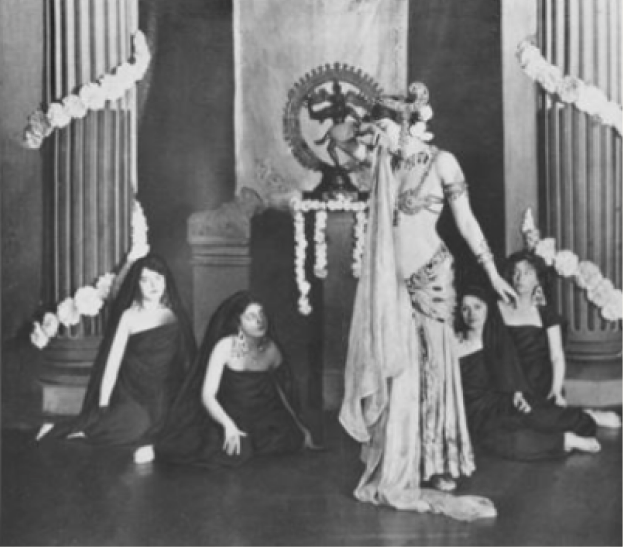
Dancers insistently presented these explorations, with no sense of conceptual whiplash, in the space of the music-hall, and this underlines that what to modern eyes might seem to be a space of utter frivolity was rather –or was also—a space for experiment, a kind of laboratory. This is a point raised time and again by defenders of the music-hall in the early decades of the twentieth century. For performers, the music-hall was a space not only to try out new choreographies and measure audience responses to them, but to experiment with foreign codes of gesture – or in the case of such a figure as Inyoka, for instance, to reimagine her own inherited forms with the eyes of a foreign audience in mind. 9 For reviewers, the music-hall became the place where dance was being rethought, where the relation between performer and public was being renegotiated, and where the audience was invited to engage with the world kinesthetically, responding to its shifting forms. As André Legrand-Chabrier proposed, the music hall was “a collection, a museum, of individuals showing us the most original and exceptional things they are capable of”; 10 or as another ardent supporter, Jacques Chabanne, put it, “A music hall revue is a kaleidoscope. In a three-hour show, the entire world passes before us”. 11 This often carried with it, evidently, the frisson of the exotic, carried over from the performance practices of the world’s fairs. There is a core ambiguity in this opening which was also, clearly, an exploitation, succinctly parsed by one of the most insightful scholars of the music-hall, Anne Décoret-Ahiha, who notes that the music hall was a “launching-pad for exotic artists” (110) even as it “turned alterity into a spectacle, akin to ethnological exhibitions and world’s fairs” (118). 12 Like a world’s fair, what it offered audiences was a fiction of travel: the illusion of being carried elsewhere, even around the world, on a “voyage immobile” as Gustave Fréjaville put it, where a dancing body performed the movements for the spectator.
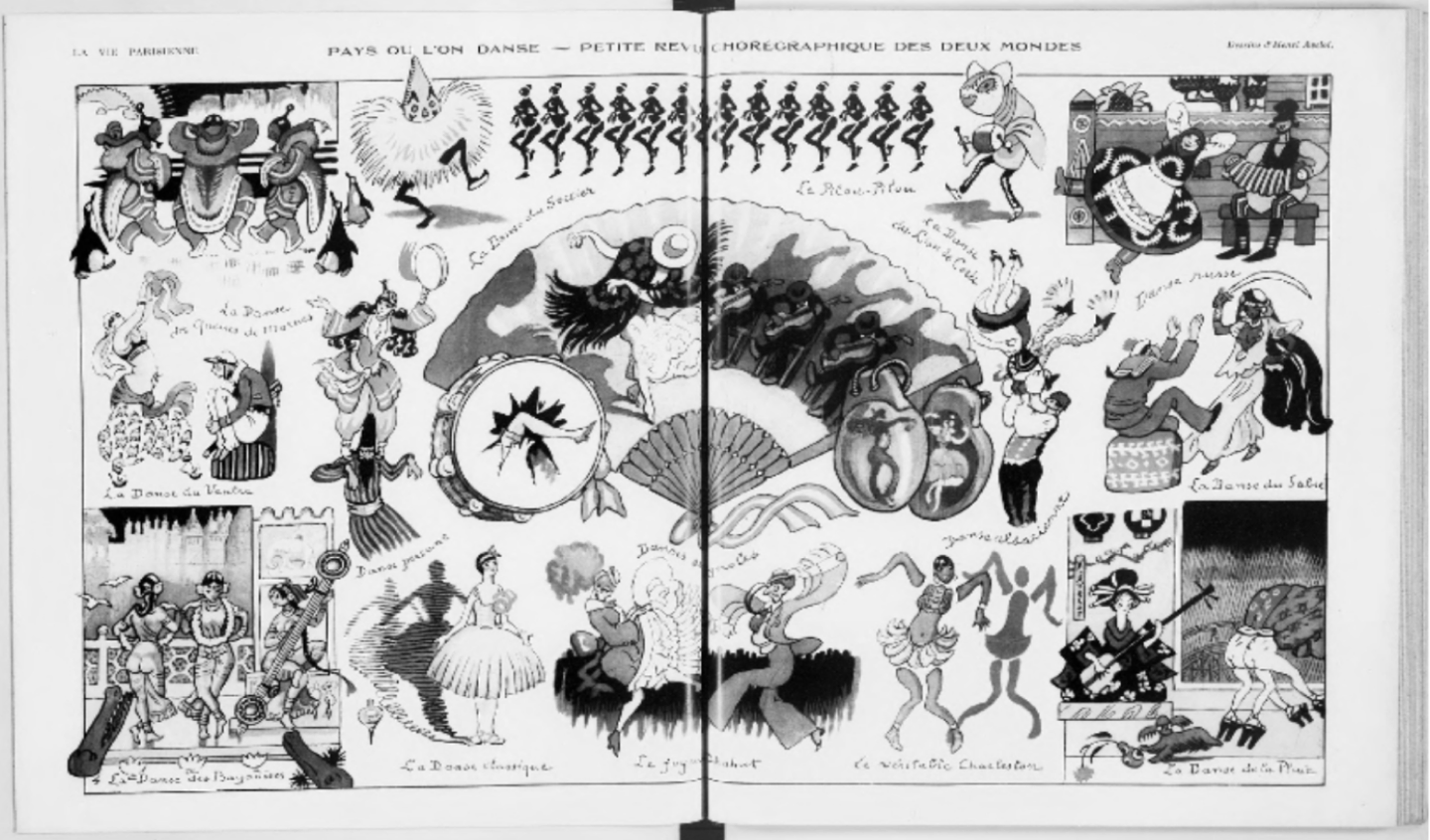
Somewhat surprisingly, the music-hall became a magnetic site of exploration for writers as well. On the one hand, it elicited some extraordinary pages in the burgeoning literature on dance that we will explore in more detail in chapter four, but whose authors we can begin to name here: the already multiply-referenced Théophile Gautier, delighted spectator of an array of dance forms and a vocal advocate for diverse ethnic styles on modern stages; French poet Stéphane Mallarmé, whose writings on dance were, as he put it, crayonnés au théatre, scribbled in the very theater where he sat and watched and tried to fix the movements of a form that dissolved before his eyes; and symbolist critic Arthur Symons, dubbed by WB Yeats a “scholar in music-halls”, who wrote penetrating pages on mutating styles of dance in the theaters of London, Paris, and Barcelona. As this last example suggests, critics were consuming dance not only in an array of theaters but in an array of cities, and as they wrote about what saw, they not only compared diverse offerings, but took note of the reactions of different publics. This was helped by the fact that they were largely watching dance in music-halls and variety-theatres, spaces of less-constrained appreciation than the Opera, where the responses of audiences were more visible (and audible, and palpable) to anyone caring to pay attention to them. Spaces where the spectator was paramount, where the ability to win over –or at least engage—the spectator was a key priority. As Symons put it, in the “admittedly frivolous” art of the music-hall, the audience itself was “part of the performance”. 13
A striking number of critics, moreover, not only wrote about the music-hall but emulated its form, mimicking its tendency toward diversity to present collections of short essays defiantly lacking an overarching rubric. Paris-based Russian critic André Levinson, for instance, in 1924 published the collection La danse au théâtre, made up of previously-published short pieces, emphasizing his decision to string them together with no more structure than they had originally had, as a way of capturing the unfolding nature of the contemporary scene. 14 A particularly interesting case is that of American Caroline Caffin, whose 1914 book Vaudeville explicitly presented itself as a set of vaudeville acts, featuring “numbers” dedicated to analyzing an array of different popular forms to be found in the popular theater. Caffin insisted that these were to be taken no less seriously than dances presented in more dignified venues, and indeed, as she underlined, several of vaudeville’s offerings were distinctly serious; pointing to the example of Ruth St Denis’ Radha, first presented in a variety-hall setting, she argued that dance had the power to train its own spectator, to instill in the onlooker a sense of its growing solemnity and significance. 15 Was the same to be said for the dance writings that appeared in these provocatively miscellaneous collections?

Caffin’s example also allows us to point to a complementary phenomenon. Alongside books engaging with variety performance itself were books presenting the immense variety of dances on display: in specific cities, but also across a circuit of variety performance that was starting to come into view. As dancers themselves were increasingly on the move, variety shows in London came to share modes and often performers with similar spectacles in Paris, Berlin, New York. As a result, books analyzing the contemporary scene in the United States had much in common with books written in Germany and France, because the same performers –or at least similar repertoires—were being shared across the entertainment horizon. One such study is a book that Caffin co-authored in 1912 with her husband Charles, Dancing and Dancers Today. 16 The book traces the various options that had developed on American soil in the two decades following the 1893 Chicago World’s Fair, from so-called “primitive” dances (or Indigenous forms which had hitherto been invisible) through dances derived from religious practices, Eastern rituals, and classical civilizations, to incipient forms of “dance drama” learned from the Russians. The Caffins paid special attention to the figures of Isadora Duncan, Maud Allan, and Ruth St Denis, three North American dancers who had triumphed on the stages of Europe by experimenting with neo-Hellenic, Orientalist, and miscellaneously ethnic forms, but they were keen to note that American dance was finally in the process of drawing upon national history and forging its own forms – pointing the reader’s eye, for instance, toward burgeoning forms of African-American dance. They nonetheless took care to insist on the importance of preparing the public to receive these new forms properly, pointedly remarking that “audiences need training as well as performers” (175). 17
Slide 1 of 3
This moment sees a growing sense among critics and dancers alike that in order to dance or to appreciate dance, one had to know its history; that multiple dance styles entailed multiple histories; and that to understand both the past and present of dance, one had to develop a comparative sense of its forms and practices. Hence the explosion of critical works aiming to guide audiences in an informed reception of this increasingly mobile and flexible art of movement. One of the most significant books of dance criticism, JE Crawford Flitch’s Modern Dancing and Dancers, appeared, like the Caffins’ book, in 1912; it takes a broad geographical view on dance, but adds to it an attempt at a global dance history. 18 Guiding his readers across a broad panorama of contemporary dance – presenting what he was seeing on the local London stage, but also what he was reading about from elsewhere—Flitch attaches the styles he sees emerging in the present to their various histories, making his book comparative not just in spatial but temporal terms. Insisting on taking dance seriously an art form, he traces its origins in spiritual and ceremonial settings across the world, its days of grandeur in court and theatrical spaces, what he sees as its collapse into entertainment in the music-hall, and its resurgence in the hands of dancers such as Duncan and Allan, both of whom, Flitch claims, were returning to its origins in order to reanimate dance as a mode of high art, indeed of exploration. Under their influence –and in tandem with the multimedia spectacles of the Ballets Russes, who not only loosened up ballet’s movements but modeled ways of drawing upon both national styles and antique forms—dance was not only recovering ancient modes of expressiveness, but transmitting an integrated body to its audiences as well, replacing the “angular, jerky, abrupt, disjointed” nature of modern human motion with flowing forms learned from the past. 19
Over the course of his book, while offering extraordinarily acute analyses of the still-emergent dance styles of figures such as Anna Pavlova, Ruth St Denis, Vaslav Nijinsky, Flitch is particularly attentive to the energies latent in an array of national styles. In a lyrical closing statement, he makes an impassioned plea for contemporary dance to open itself to the world:
there is a whole world of gesture waiting for the dance to take possession of. The rediscovery of the gesture of the ancient world is perhaps the least important part of the undertaking. There lies a broad field for exploration in the innumerable racial and national gestures, each with its separate beauty, and its separate expressiveness. And beyond this stretches the yet more inexhaustible domain of nature, its multitudinous minor rhythms, each various and distinguishable, merging into a grand rhythm of the whole, the eternal rhythm of life itself. Fragments of attitude, phrases of motion, are scattered prodigally up and down the world, awaiting the seeing eye and the understanding mind that can pluck these happy accidents, store them in the memory, and at the proper time build up out of them a new pattern of the dance. (221)
Although we might be tempted to hear this, from our contemporary perspective, as a call to appropriation, in line with the primitivism operative within the world of the visual arts at the same moment, I would suggest that we hear in it instead a call to conversation, an optimism in the potential of different dance styles to enter into dialog: each with their own “separate beauty” and “separate expressiveness”. This is one of the moments when dance merits being thought of in linguistic terms, with different styles taking the form of different languages: languages that might be learned and shared and borrow from one another rather than simply imposing themselves or reinscribing hierarchies. And indeed it is striking how many dance critics in the period were also translators – or to put it the other way around, how many translators were dance enthusiasts. This was because dance, as a silent art but an immensely eloquent one, was increasingly affirming itself as a practice in ongoing and flexible contact with the world in which it found itself, and to which it made itself porous. Or to quote Francis de Miomandre, French translator of Latin American texts in the 1920s and 1930s and the author of the comparative study Danse in 1935, « dès qu’il tourne, [le danseur] n’est plus lui-même, il est détaché, pour si peu que ce soit, de la pesanteur, il appartient à l’univers » [once he begins to turn, the dancer is no longer himself; he detaches, however lightly, from gravity, and belongs to the universe]. 20 A detachment turning into a series of attachments, as we will begin to explore.